
To illustrate how framing tends to work, let me present a table setting out conversion and/or non-conversion to another frame, the two basic frames being a monotheistic religion and modern secular atheism. The details within the table, i.e. columns 2-4, are not meant to comprehend all possible reasons and frames for these four groups of persons. Since every person’s character and background are unique, there is virtually no limit to what I could offer here.
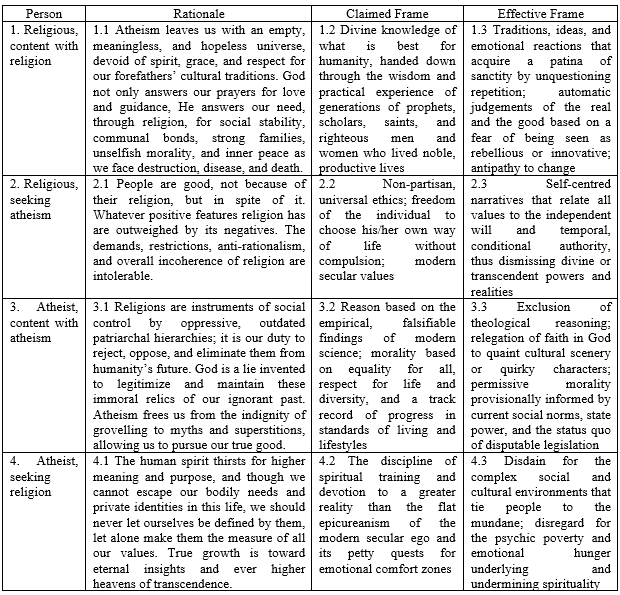
There is nothing definitive or precise about the contents of this table. My purpose, rather, is simply to indicate how the same issue, i.e. religion vs. atheism, can be framed in various ways, all of which appear valid to their proponents and one-sided by their critics. God can be taken as a frame that includes everything, because God creates all things, or that includes nothing of truth or value, if God is considered as a fabrication. In the former case, God puts everything in its place; in the latter case, God is assigned a dishonourable place in a greater frame called Reason or Justice. The aim of this book, of course, is to unfold the former view, that GOD is the Ultimate Frame, insofar as He encompasses everything. Underlying this, however, is my concern for recognizing that Ultimate Frame, regardless of the term we use.
Critics may complain that by naming that Ultimate Frame GOD I have already fabricated a frame that is no longer ultimate, but biased towards monotheistic religion. Fair enough. I accept that accusation as possibly well-intentioned and just. I would only add that there is no term that escapes some sort of bias, including “Ultimate Frame” itself, with its connotation of being just another mental construct in the universe of intellectual things that are conceived by human minds. When I say “GOD”, I mean not only something that surpasses all our terminology, imagination, and experience, but also One Who creates and frames our terms, images, and inner life in His – the Ultimate Framer. I want my use of “GOD” to be as infinitely beyond as anything or anyone can be. If “GOD” is not the word for that, I welcome alternative terms like the ones that I have already used (e.g. the Personal-Suprapersonal Absolute). “GOD”, in any case, gets the job done with only one syllable and three letters, so I will continue to use that term.
 The GOD You Already Know