
Constructing frames to make sense of our lives and what we believe is something all of us do, all the time. What we do naturally might as well be done compellingly. My aim, therefore, is to make this frame, the conceptual structure of this book, substantial, coherent, and effective on as many levels as possible, primarily for myself. When it can incorporate the message of the Qur’an in a way that answers my needs and addresses the challenges thrown at us by the world, it has served its purpose. Then, when I am struggling no longer, I can put that armour aside and return to my Lord, with Whom my final doubts will be resolved in peace.*
*One common misconception about the Qur’an, and hence one that almost certainly affects any reading of this book as well, is that the Qur’an should corroborate our current versions of material or historical reality, and so can be or should be subjected to the ordinary processes of scientific or historical verification. Are there really seven heavens, fashioned in two days? Are there beings actually made of smokeless fire? Did Musa (peace be upon him) actually lead his people through the Red Sea? Was there really a first man, Adam, the father of all mankind? Where are Hell and Paradise located?
People who conduct these investigations think that if they can discover any detail in the Qur’an that does not correspond to the latest scientific findings, then they have proved it to be false, i.e. not from GOD. The same type of judgement is used with regard to social or moral issues, such as references to women, war, slaves, or ‘barbaric’ punishments that offend our contemporary norms. But norms continuously change, and so do the findings of science.
Once we begin to accept these alternative frames as standards, there is no end to them, and we are left with a whirlwind of doubts about everything except our own judgements. Rather our questions should be: how does the Qur’an raise the mind and soul of the reader into a state of constant readiness to face Infinite Truth? Can we learn, by way of His Book, how to affirm His Transcendental Oneness and, through Him, the ultimate beauty and rightness of His creation, regardless of our present conditions and points of view? Can we discover in His Book our immanent affinity with Him, and return to GOD both pleased with and pleasing to Him?
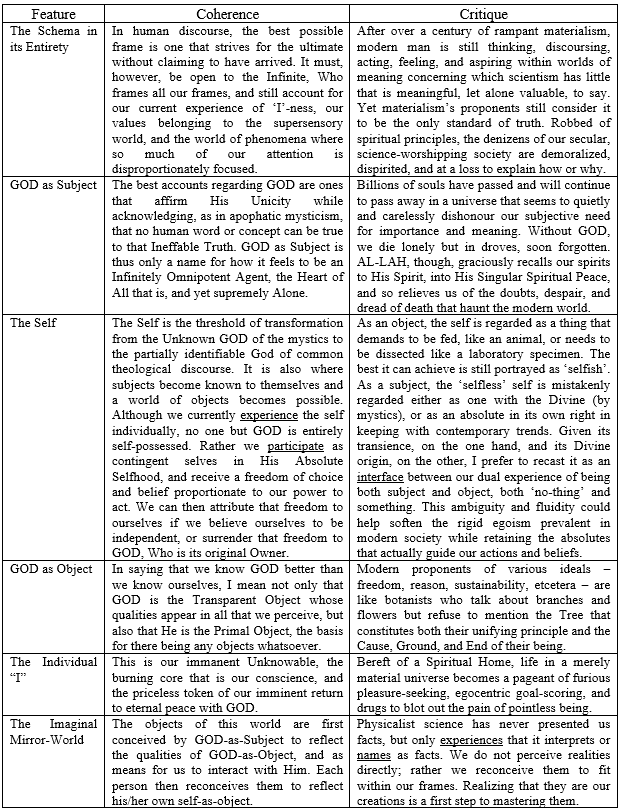
The schema of the previous Chapter can be elucidated by what it achieves defensively (coherence) and what it aims to accomplish dynamically (critique):
But does this framing really affect personal behaviour? Is it practical in any way? Or are these “Ideas” simply an elaborate rationalization for how we are determined to live, regardless of theory?
 The GOD You Already Know