(42)
She was asked when she arrived, “Is your throne like this?” “As if it were,” she said. [Sulaiman remarked], “And we received the knowledge prior to her while we were submissive.”
فَلَمَّا جَاءَتْ قِيلَ أَهَكَذَا عَرْشُكِ قَالَتْ كَأَنَّهُ هُوَ وَأُوتِينَا الْعِلْمَ مِنْ قَبْلِهَا وَكُنَّا مُسْلِمِينَ
The brevity of her response (and of the commentary in Ibni Kathir accompanying it) seems to belie the importance of this moment. Yet everything in the narrative thus far – the report from the hudhud, the message sent by Sulaiman (peace be upon him), the queen’s evasive response, the threat of invasion, and the ‘abduction’ of her throne – has been leading up to this: As if it were.
Immediately upon her uttering these four words, Sulaiman (peace be upon him) turns to the reader (like the hudhud earlier in verse 26) and begins to speak about knowledge and submission. What was it about her utterance that would prompt his remarks in this and in the following verse?
First of all, it should be remembered, the purpose of this test was to see if she will go aright or is among the ones who are misguided. I mentioned two potential escape routes for her that would signify misguidance, namely proud rejection or a humiliating loss of integrity. Fortunately, for us and for her, she is intelligent enough to see a third path midway between the two. This middle way represents the important first step on the road to the knowledge gained by those who submit.
Sulaiman (peace be upon him) interrupts the narrative here* to inform the reader that this same knowledge she has just glimpsed had been obtained by him earlier, but in a state of submission. The active intellect receives authority, and hence knowledge, while the confused intellect takes authority, and remains bewildered. (From this is derived the Islamic conception of valid political power – appointment by an authority rather than ‘running’ for office, with divine knowledge preceding and conditioning worldly authority.) This explains why he called upon her to submit from the outset; he wanted her to participate in the same experience of wisdom and gratitude that had come to him by means of submission to GOD. The queen has yet to express her submission, but she has begun to see, through this lesson of the altered throne, why she should. So what is this knowledge that Sulaiman already had through submission, and hopes that she might have now by saying As if it were?
* Some translators and commentators construe these words beginning with “And we . . .” to be those of the queen herself, since there is no explicit mention of a second speaker in this verse.
But Ibnu Kathir and his sources are in no doubt that this second speech belongs to Sulaiman (peace be upon him) given that 1) there is no indication prior to this of her having received the knowledge; 2) the third-person pronoun her (or it for feminine nouns) has no obvious referent besides the queen herself; and 3) her speech of submission is reserved for the last verse in this narrative, namely Q27:44, where it provides a resounding and satisfactory conclusion that would be practically pointless if her submission had already occurred at some indefinite time not even mentioned in an earlier passage.
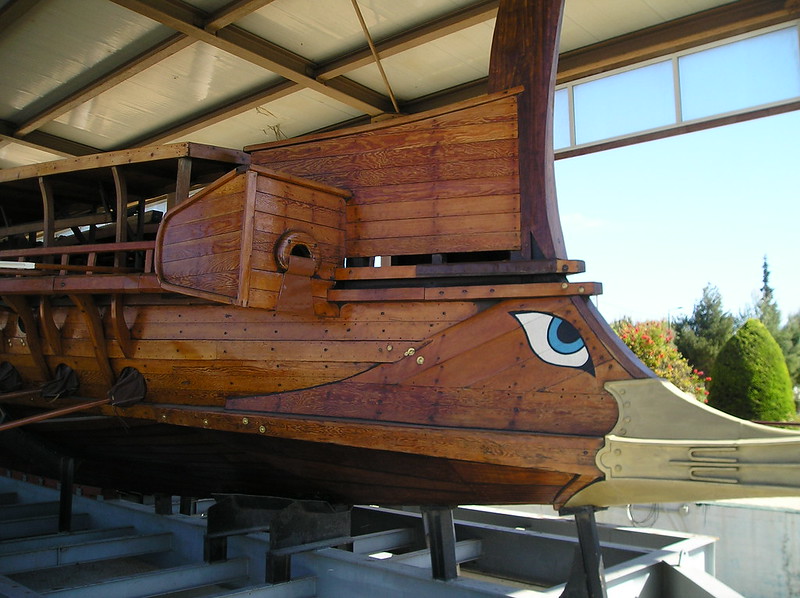
The queen’s altered throne is the Qur’an’s version of the philosophical conundrum commonly known as the ‘ship of Theseus’.
The ship wherein Theseus and the youth of Athens returned had thirty oars, and was preserved by the Athenians down even to the time of Demetrius Phalereus, for they took away the old planks as they decayed, putting in new and stronger timber in their place, insomuch that this ship became a standing example among the philosophers, for the logical question of things that grow; one side holding that the ship remained the same, and the other contending that it was not the same.1
The question posed to the queen, then, is: Has your throne maintained its identity or lost it? It has obviously undergone some change. Can it be considered the same thing or not?
The throne has two aspects: its material nature as a thing, and its symbolic meaning, namely authority. If the queen says, ‘That is not my throne,’ she would be emphasizing its authority, which should not change, over its thingness, its mutability. Her throne is clearly still a thing, as is the sun she worships, but she would be trying to limit the loss of her authority by minimizing the possibility of its being transported and altered. Consequently, her authority would be severely limited in scope to one place and one time, namely where she left her throne and when she left it, and the contradiction between actually being a thing and her refusal to admit change would be clear and recurrent.
Alternatively, she could say, ‘Yes, that is my throne,’ emphasizing its thingness, which is obvious, over its authority. Her legitimacy would be impaired by accepting its mutability and consequent loss of integrity, but she would at least be a credible witness to what things are, namely changeable. Once again, a contradiction would arise between her throne’s status as a mutable thing and the need for a constantly reliable authority.
The queen cleverly avoids taking either position. She neither affirms nor denies, but simply admits the resemblance: As if it were. She remains in suspense between two contradictions, both of which are occasioned by the conflict between what things are – changeable – and what authority entails – lasting, or even everlasting, integrity. It is recognition of this dilemma that prompts Sulaiman (peace be upon him) to speak of his prior knowledge regarding this same issue – the incompatibility between the phenomenal realm and the true legitimacy that comes to him by submission to GOD.
1 Plutarch, The Lives of the Noble Grecians and Romans, Great Books of the Western World, vol. 14, page 8
 The GOD You Already Know