(44)
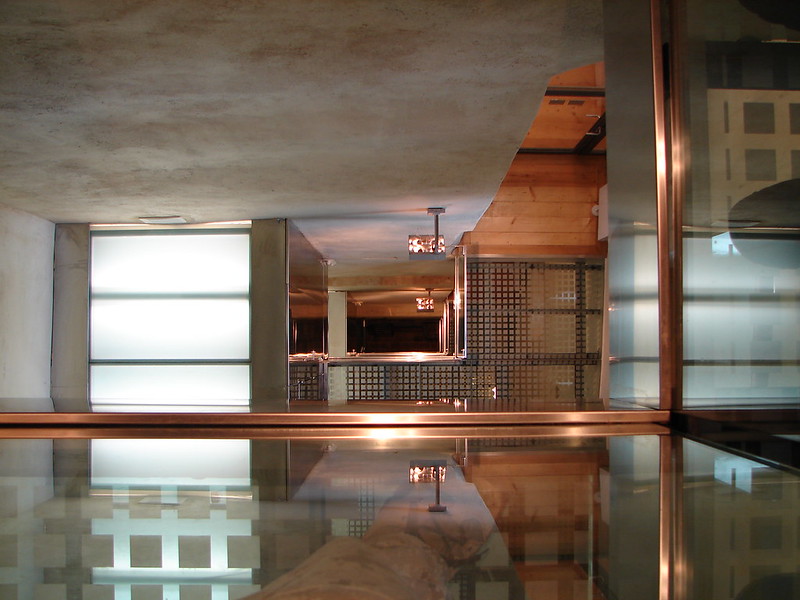
“Enter in the palace,” she was told. But when she looked, she thought she saw a pool and bared her shins. Said [Sulaiman,] “It truly is a hall [whose floor is] glazed, from crystal.” She exclaimed, “My Lord, I have indeed transgressed against myself, and I have made submission [now] with Sulaiman unto AL-LAH, the Master of the worlds.”
قِيلَ لَهَا ادْخُلِي الصَّرْحَ فَلَمَّا رَأَتْهُ حَسِبَتْهُ لُجَّةً وَكَشَفَتْ عَنْ سَاقَيْهَا قَالَ إِنَّهُ صَرْحٌ مُمَرَّدٌ مِنْ قَوَارِيرَ قَالَتْ رَبِّ إِنِّي ظَلَمْتُ نَفْسِي وَأَسْلَمْتُ مَعَ سُلَيْمَانَ لِلَّهِ رَبِّ الْعَالَمِينَ
In Chapter 4, I mentioned the “dark room” of our internal life that defies our most determined efforts to identify and articulate its secrets. Consequently, as we saw in the story of Nasrud-Din looking for his ring under the street lamp, we launch our search for those secrets in places where we are wont to look – in the domain of visible objects and concrete images. People have a constant, almost irresistible need to locate their gods where they can either see them clearly, like the sun, or where they can reach out and touch them, carry them, clothe them, and feed them, as they do with Buddha images, Hindu idols, and Christian icons and relics. Besides the psychic satisfaction and aesthetic comfort these things provide – a kind of spiritual snack food for the masses – I consider these false gods and pseudo-authorities to be projections of what we imagine ourselves to be. We want not only to have those absolutes of knowledge, power, and permanence, but we want to see ourselves and to be seen as having them. In other words, we want to be gods . . . though we know very well that we are not (hence the incoherence of the confused intellect). But we can project our ideal selves onto certain select objects, sanctify and deify them, and derive some vicarious satisfaction from worshipping these ‘incarnations’ of our profoundly dark and impenetrable selves.
Delving even more deeply into our motivations, however, I detect a certain smugness, in both these idolaters and their detractors, among whom are the latest crop of atheists and critics of religion. The atheist says, ‘I am not so foolish or desperate as to submit my reason to an icon, or an idea, or anything that claims to have spiritual authority. I am a person, an enlightened individual; I am above that.’ But those who only worship idols to bring us closer to AL-LAH enjoy a similar sense of superiority; they too believe that they are select individuals, enlightened by their exclusive relationship with an idol or deity that is given to them as their belonging. They submit their higher personality to a lesser thing as a kind of divine condescension, an incarnation of their godlike nature in a form they can look at, handle, and yet retain as supremely theirs. They simultaneously look up to it as a god and look down on it as what they made, thought up, or chose as their own. And they constantly find it where they choose to look for it, under the street lamp of their own imagination. (Even professed monotheists can have this kind of degraded conception of God when He is little more than an object, an idea, or a possession by which they flatter themselves as superior to others.)
Such an inversion can take place because, while a throne may symbolize an authority that lasts beyond one’s own lifetime, one sits on it. You are only a temporary successor to that majesty and privilege, which will remain in place after you have passed away. During your reign, however, you enjoy the complete illusion of being in command. You occupy the throne, wear the crown, wield the sceptre, issue the royal decrees, and receive the praises of your courtiers as instruments of your imperium. When Sulaiman (peace be upon him) discredited the queen’s authority by tampering with her throne, he made her see the emptiness and unreliability of those symbols and paraphernalia of royalty. But he had not yet reached in to touch the source of those symbols, that core of egoism and self-worship that produces all our pretensions to grandeur, goodness, and godliness.
In this narrative, therefore, Sulaiman (peace be upon him) has no throne associated with him. Rather he inhabits a palace – a building which encloses him and all who enter it. In similar fashion, we are not invited to acquire Islam, the state of submission, but to enter it:
O believers! enter altogether in submissiveness and follow not the footsteps of the Devil. (Q2:208)
يَا أَيُّهَا الَّذِينَ آمَنُوا ادْخُلُوا فِي السِّلْمِ كَافَّةً وَلاَ تَتَّبِعُوا خُطُوَاتِ الشَّيْطَانِ
The palace, like Islam, is not something we can dominate or use; rather it overawes us by its grandeur and beauty.
The queen enters with all the dignity and magnificence she can muster under these circumstances. Unexpectedly, however, she sees that she will have to wade through a pool of water. A water-soaked gown would be a clumsy, embarrassing hindrance to a proper regal gait, and so she lifts her dress. In doing so, she reveals her lack of knowledge and vision. She fails to see the stable glass above the unstable water because she considers the invisible to be nonexistent.
By taking this ordinary precaution to keep her dress dry, the queen’s confused intellect admits that she expects to be immersed in the changing, inconstant water of this world, the realm of things, and to be impeded, if not dragged down, by it. Our natural tendency (fitrah) is to avoid getting engrossed with things, for our true nature belongs to GOD, the Everlasting, the Knowing. The queen, embarrassed by her faux pas and her exposure, has by this momentary lesson been made to see 1) the folly of her devotion to what she in fact seeks to avoid, and 2) who she truly is when granted self-awareness. The glass reveals that she can virtually walk on water, i.e., separate herself and her authority from that immersive domain below. (The worshippers of this world, contrarily, encourage and celebrate this immersion and changefulness, for they are in denial of any higher realm.)
Water has its place within the palace of Islam, and the life of this world (al-hayatud-dunya) indeed requires it. This is why Paradise is described as having rivers flowing beneath it; they represent the undercurrents that both remind us of our past and help us see why outgrowing that transience is forever delightful. But the failure to see the reality of the glass above the water of this world is ultimately fatal; like the people of Nuh (peace be upon him) and the army of Fir’aun, we drown in the floods of our ignorance, or are swept away, if we lack faith in a higher reality.
The confused intellect is unprepared for that loftier, spiritual dimension – the crystalline floor of GOD’s Kingdom. With the perspective of the active intellect, we are able to stand firmly on it and step forward confidently (as in the truthful footing with their Lord of Q10:2), while seeing even more clearly than before what water is, how it moves (“made to flow” as per Ibni Kathir’s commentary), and how it submerges those who have no higher ground to save them from it. This incident reveals not only that Sulaiman (peace be upon him) has a kingdom and authority greater than the queen’s, but that his knowledge is greater and more reliable as well. Her throne was transformed, but not destroyed; now she too has been guided, transformed, and yet remains a queen. She has lost nothing but her illusions, and has gained the security and awareness she has long wanted, long before she complained about what the kings of this world do to worldly kingdoms. She repents of the harm she was doing herself and instantly and gladly submits to the true King of kings, the Creator and Sustainer of all worlds above and below, and the Real Source of Power, Authority, and Wisdom.
By this acceptance, she has attained the same level of understanding enjoyed by Sulaiman (peace be upon him) himself, which is why she does not simply announce her submission to AL-LAH but specifies that it is with Sulaiman. Implied in this are the three stages of the developing soul mentioned in the Qur’an.
The first is the inciting or commanding soul: And I do not absolve myself of sin. Indeed the self incites to wickedness, except for that on which my Lord has mercy. (Q12:53) This represents the confused intellect who was described earlier by the hudhud: Satan had adorned their acts for them and led them off the path so they would have no guidance / [Telling them] not to make prostration to AL-LAH. When we follow our desires regardless of what is right or true, in ignorance or denial of GOD, we are headed to wickedness, and the devil is the driver.
The second is the accusing soul:
No, I swear by Resurrection Day / And no, I swear by the accusing self. (Q75:2)
لاَ أُقْسِمُ بِيَوْمِ الْقِيَامَةِ
وَلاَ أُقْسِمُ بِالنَّفْسِ اللَّوَّامَةِ
This is the resurrection of the inciting self, which is then judged not only by GOD but by its own conscience. As the chief weapon of the accusing self, the conscience ‘resurrects’ the misdeeds of the inciting self. Without such painful exposure the confused intellect would never learn that I have indeed transgressed against myself. It is the task of Sulaiman (peace be upon him) to represent this investigative effort, examples of which we have seen in this story when he was interrogating the hudhud and threatening the queen herself. Yet this severity indicates a conflict and division within the soul – one that the active intellect is determined to overcome.
Thirdly we have the tranquil soul: O you tranquil soul! / Return to your Lord, satisfied and satisfying! / Enter in among My servants. / Enter in My Paradise. (Q89:27-30) Finally, after the tribulations of examination and punishment, we have reconciliation, internal and external harmony, and eternal victory. Here is the real meaning of the queen submitting with Sulaiman unto AL-LAH, the Master of the worlds. She is no longer confused, and Sulaiman (peace be upon him) has nothing more to do or say by way of action or accusation. The active intellect has absorbed and pacified the experiences, talents, and possessions of the previously confused intellect in its greater kingdom, one that is fully submissive and open to the Kingdom of the Real, and our story ends where it began, in glorification of GOD.
 The GOD You Already Know