The material in this blog is now available at amazon.com under the title: Ideas Inspired by the Qur’an.

Before I go any further, a table of comparisons may help to clarify how radically opposed Qur’anic Reality is to what passes as reality in the media, the schools, and common conversation.
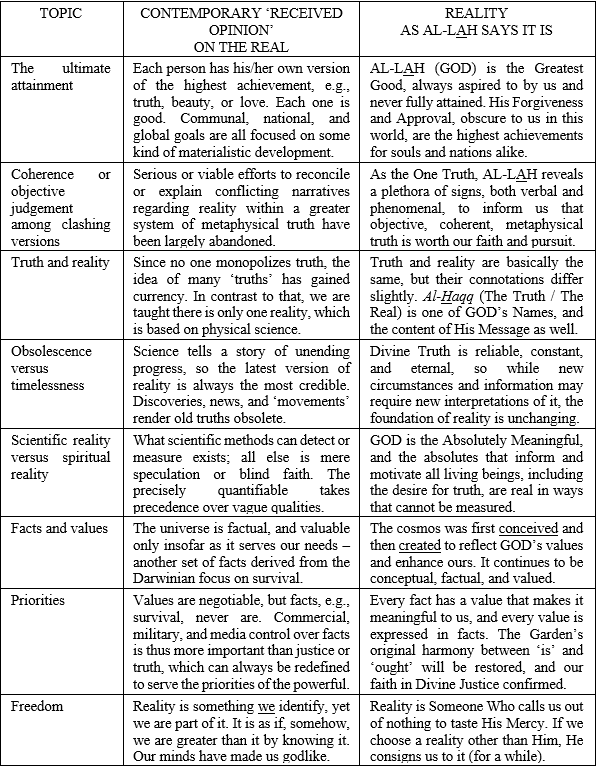
It is a misconception of the gravest consequence to think that this entire field of discussion is of no importance because it is not practical, but only theoretical. An honest reader of the Qur’an will come to the opposite conclusion – that there is nothing more practical than this. What is real and what is true are matters of life, death, and eternity, in comparison to which your so-called practical concerns such as home ownership, reputation, career, social life, and even your health and temporary happiness will soon appear trite and minuscule, if not delusional. Consider the following (Q10:54-56) as just one passage among hundreds like it in the Qur’an:
If every unrighteous soul owned everything on earth, they would relinquish it as ransom. And they would hide their self-reproach when punishment came into view. And justice would be done among them; they would not be treated wrongly. / Verily to GOD belong the contents of the heavens and the earth. Indeed the promise of AL-LAH is true, but most of them know not. / He gives both life and death and unto Him you are returned.
وَلَوْ أَنَّ لِكُلِّ نَفْسٍ ظَلَمَتْ مَا فِي الأَرْضِ لاَفْتَدَتْ بِهِ وَأَسَرُّوا النَّدَامَةَ لَمَّا رَأَوْا الْعَذَابَ وَقُضِيَ بَيْنَهُمْ بِالْقِسْطِ وَهُمْ لاَ يُظْلَمُونَ
أَلاَ إِنَّ لِلَّهِ مَا فِي السَّمَاوَاتِ وَالأَرْضِ أَلاَ إِنَّ وَعْدَ اللَّهِ حَقٌّ وَلَكِنَّ أَكْثَرَهُمْ لاَ يَعْلَمُونَ
هُوَ يُحْيِ وَيُمِيتُ وَإِلَيْهِ تُرْجَعُونَ
Modern orthodoxy assumes a frame of reference that excludes these eventualities – the sudden exposure of hollow values, our panicked remorse when confronted with a pure justice that has morphed into Absolute Reality, our limited knowledge of this inevitable state, and our imminent return to it. Preparing for that Day is by far the most practical thing you could ever undertake to do in this world.
The Qur’an is not constructed like virtually all books we encounter, including this one. It does not divide up its initial theory into tidy chapters with a predictable, plodding progression, and then rise to an exhortation to action at the end. Rather it ambushes you – Verily your Lord is watching, waiting (Q89:14) – from any direction, be it theory, law, prayer, practices, story, symbol, promise, or warning, at any moment, as if to say, ‘Don’t assume what the right order of subject matter should be! Wherever you are in your reading, consider this now!’ It is a course of training in alertness, a literary dojo where the master wants you always on your toes. It is this ontological, spiritual, and ethical urgency and pressure, and in an unfamiliar format, that many modern Westerners find disorienting and offensive. The Qur’an, in short, was meant to be challenging – and personally so.
Shall we get to it, then? What are the challenges?
 The GOD You Already Know