Challenge #9: Reality is vertically gradated.
When we talk about other absolutes, we expect degrees of purity, intensity, relevance, or comprehensiveness. We can speak of one type of flower being more beautiful than another, a decision that provides greater justice, or a forecast that is more accurate. So why do we insist that reality be ‘flat’, in one dimension, either ‘on’ or ‘off’, like a light switch?
I believe it is because we have accepted the claims of scientism to speak for reality. In science, valuations, appraisals, and insights are rigorously excluded, and all facts are equal in the court of nature’s laws. For the scientist, ‘more’ is a measurable quantity, not an amorphous quality. Values like lovely or more lovely have no scientific meaning. Consequently, scientism’s answer to ‘What is reality?’ is ‘Whatever can fit within our frame’ – a simple digital yes (real) or no.
When I insist, contrarily, that ‘real’ is an absolute, like ‘beautiful’ or ‘just’, I must also affirm that things, concepts, and even persons can be more or less real. They are varying degrees with GOD. And GOD is Seeing what they do. (Q3:162-163) Reality is hierarchical in nature, cascading down from GOD to His angels, His messengers, His beloved servants, His ordinary creatures, His opponents and detractors, and finally even His demons and other denizens of Hell. A similar gradation from high to low reality can be asserted in terms of knowledge, from the Qur’an to the trashiest tabloid, in terms of places, from the Holy Sanctuary to the sites of massacres or temples of usury (the banks), and in terms of activities, from performing a prostration during worship to doing a drug deal. The fact that they are all persons, or are all printed materials, or are all places, or all actions, is merely a fact, and it is in the nature of ‘facts’ to cram all realities into a single-level dwelling, a numerical mass grave.
The blind and sighted are not equal, / Nor are darknesses with light, / And neither is the shade with grievous heat. / Not equal are the living and the dead. Indeed AL-LAH lets those He wishes hear. And you cannot give hearing to the people in their graves. (Q35:19-22)
وَمَا يَسْتَوِي الأَعْمَى وَالْبَصِيرُ
وَلاَ الظُّلُمَاتُ وَلاَ النُّورُ
وَلاَ الظِّلُّ وَلاَ الْحَرُورُ
وَمَا يَسْتَوِي الأَحْيَاءُ وَلاَ الأَمْوَاتُ إِنَّ اللَّهَ يُسْمِعُ مَنْ يَشَاءُ وَمَا أَنْتَ بِمُسْمِعٍ مَنْ فِي الْقُبُورِ
Challenge #10: Reality is valuable.
Reality is, as I said earlier, a synonym for GOD Himself and hence extremely Personal. But if reality were a thing – which happens when we conceive of it as an ‘It’ rather than a ‘Him’ – then reality would be the most valuable thing in the world. Every living thing necessarily dies for it (and a few devoted truth-seekers would willingly die for it). It is impossible to overstate the value of Reality as our ultimate goal, and yet most of us fail to see how that, in turn, makes it hard to overstate the scale of reality in values, particularly in contrast to supposedly value-free facts. By way of clarification and summary, I provide here two examples.
1) There is an emblem of a flower on our box of tea bags in the kitchen. The emblem was produced by an industrial artist, or copied from a graphics library somewhere, and then mass-printed onto hundreds of thousands of similar containers. The artist, the graphic designer, the printer, and the other professionals and wage-earners who worked to put that emblem there make a living from such work, which helps sell the tea bags and make money for the manufacturer, wholesalers, and retailers of that item.
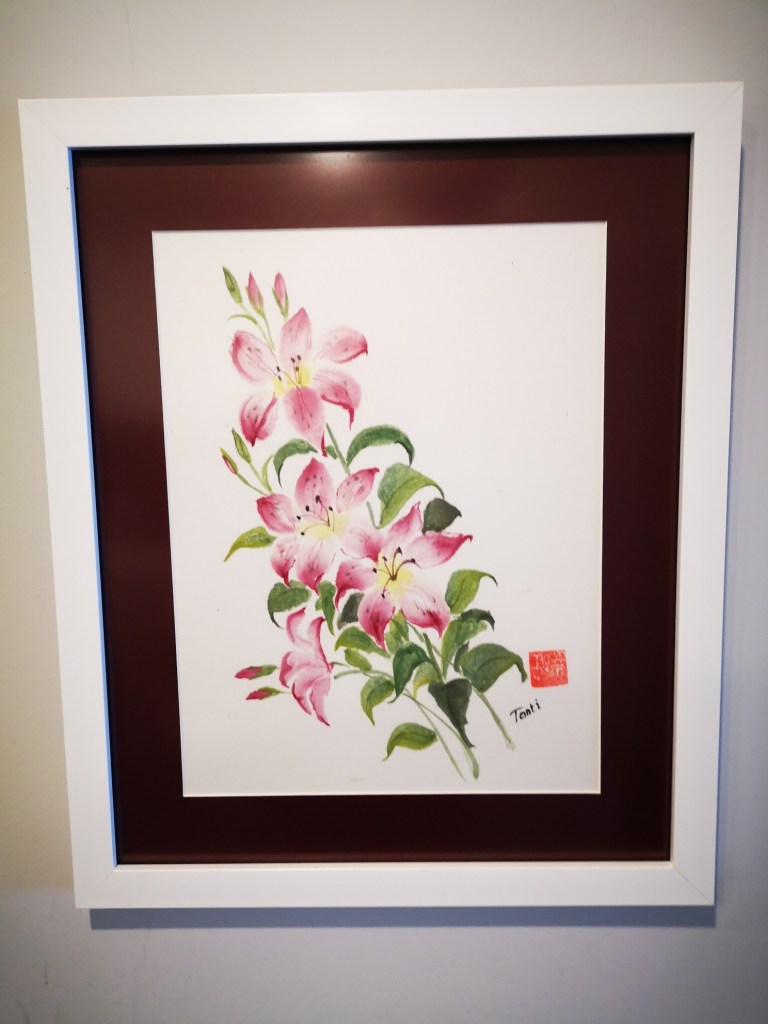
Also at home, on the wall in the kitchen, is a painting of a flower. My wife spent hours painting it, and I spent money to have it framed. Although not professional, the picture on the wall is far more valuable to me than the graphic on the tea box. Why?
Despite it being the work of an amateur, the painting is not only detailed but also beautiful. It took hours to create, displaying care, imagination, keen attention, a desire to improve her technique, and a love of artistry free of any thought of remuneration. Monetarily, it and its frame represent a loss to me, but our gain in the intangible values I just mentioned is incomparably greater. Its existence is a fact, but a fact with wings that take us up to a heaven where GOD’s Care, Creativity, Attentiveness, Compassion for humanity, and Love of beauty are more deeply felt and more clearly manifest. I see in it a little of GOD’s Personality, something of my wife’s, and something of the relationship between them. The values in it are hard to define – elusive – but their manifestations are abundant – effusive. I find those values meaningful and affecting. The work began as a concept, blossomed into a painting, and represents multiple levels of the same reality I am seeking by other means, as I type these words.
A critic might object, however, that these are only feelings, and entirely subjective. Of course they are. What the critic wants is a reality that reflects his concern for quantities – the number of jobs ensured, the amount of money made, the contribution to the GNP, and so on. But that concern, too, is only a feeling, no matter how many people count it more important. That subjectivity is also real, but at a lower level; it is less real for me, and those involved in it might agree if I were to invite them to my home to admire my wife’s painting. The image on the carton faintly reminds us of some of GOD’s qualities, such as being the Provider of human sustenance, but in a back-handed, dispiriting way. People are paid to put little graphics on tea cartons, but without the esthetic delight and love that they paint flowers at home unpaid. Two subjective realities are produced – one that is basically pure, tending upward, and possibly never to be remembered by anyone but GOD, and another that is a fleeting, sensory impression, lost in the hum of machinery and the banality of grocery shopping. Value is always subjective, even if everyone agrees on it. Yet it is our subjectivity, our personal relation to Reality, that will be judged by One Whose Subjectivity has unfolded into the Ultimate Objectivity of being GOD.
2) Agatha is a housewife with two young children. Although she has a university degree, and could have succeeded in a career, she decided to sacrifice her prospects outside for domestic security and the responsibilities of motherhood. She thought, at the time, that it was the right thing to do. Now, however, after three years at home, she is bored, frustrated, and regretful. She has discovered, to her chagrin, that looking after infants is a chore for which her education and student activities gave her no emotional or spiritual preparation. She has no religion, no underlying faith to fall back on as consolation, and very little social support. She carries on with the drudgery of home-making, but her heart is no longer in it. She wants out, and is impatiently scanning the chances of affordable pre-school placement for her young children.
Rosalie, on the other hand, is a successful lawyer with a hefty income, a carefully curated independence, and an active after-hours social life. But the empty glitter and vapid pleasure have begun to pall, and she has come to realize how exhausting and relentless the career ladder can be. Is she running out of time to have a family? Perhaps it wouldn’t matter if she simply forgot about children. Her friends coax her into more vacations, more binge drinking, and more shopping. Yet the constant round of work and pleasure is starting to feel tawdry and meaningless. What are the real values worth pursuing in life?
Neither Agatha nor Rosalie made their choices based upon clear pre-existing absolutes, but assumed that whatever values coincided with or followed on from their choices would be comfortable and right. They did not ask what values would be inherent in or implied by their chosen situation, i.e., a moral outlook suitable for life at home, or the questionable ethics that complement a competitive, glamorous work environment. And until they can identify what values they have, on the one hand, and what values they want, on the other, they will continue to be haunted by thoughts of ‘could be’, ‘what if’, and ‘who cares?’
More importantly, neither of them ever asked themselves, ‘Given who I am, what does GOD want from me?’ What are His values for me? That would be a paradigm shift of enormous importance, as only GOD has the power to make ‘ought’ become ‘is’, to convert our distant ideals into the realities of the living present.
***
Values provide the motivations and feelings we need to accept any set of circumstances, no matter how adverse, but that acceptance requires both conscious effort and a careful choice of environment and companions. (Not everyone has the luxury of external choices, but we can all work on our internal, personal culture and the attendant spirits of our private lives.) What makes these values real is that we can strive at selecting them as consciously as we choose anything else in this world, and then watch them work their magic on our attitudes, our relationships, and our sense of meaning and achievement. But if we dismiss them as mere wispy concomitants of facts, as fleeting as our preferences in food and entertainment, they will continue to hover around us like dark clouds, obscuring our sense of self and obliterating our awareness of GOD.
Our time in this world is spent against the background of His suspended Judgement, and the values we follow, whether keenly or carelessly, are His messenger-spirits, whispering to us of a certain fate that we can see in their faces, if we dare to look.
 The GOD You Already Know