1) In Q21:30, AL-LAH says,
We made from water every living thing.
وَجَعَلْنَا مِنْ الْمَاءِ كُلَّ شَيْءٍ حَيٍّ
Commentators are likely to focus on the ideas of water and life, and how the latter depends upon the former. But of greater importance – and relevance to the present discussion of Q10:24 – is the We that precedes it all. Without GOD, Who is the Living (Al-Hayy), and not a thing, there is neither water nor life, nor anything at all. The use of We in We sent down emphasizes that GOD is much more, to us and in His Own Being, than some kind of impersonal cosmic force. He is both Absolute Reality and Absolute Personality. And insofar as we are persons, we are more real to Him than anything else, and more real to ourselves as well.
One could say, therefore, that ‘personal’ correlates with ‘real’. The more personable someone is, the more real we find him to be. We all know and feel that to be true, intuitively, at some deep level of our being, but scientism has succeeded in convincing many of us otherwise, to our great shame and loss. The more modern humanity becomes enthralled by its heartless, bureaucratic systems of production, management, communication, and education, the less real and the more robotic its participants and promoters become. Their hearts harden, their faces turn dark with pride and greed, and Satan convinces them that they are masters of the world rather than his slaves. Then the wealth and power such satanic systems bring cause these pseudo-humans and psychopaths to all act and talk and think the same way, for the same predictable ends.
That is when Our Command arrives – when Personality resumes its reign at last. Amid the darkness and unreality, however, His guidance was always available to the one who was willing, or the one He willed (Q10:25). Both meanings are possible in the Arabic, and the ambiguity, I believe, is intentional. It shows that when He wills to guide someone, it coincides with and confirms that person’s own willingness. Such a convergence in a higher Reality is only possible between persons.
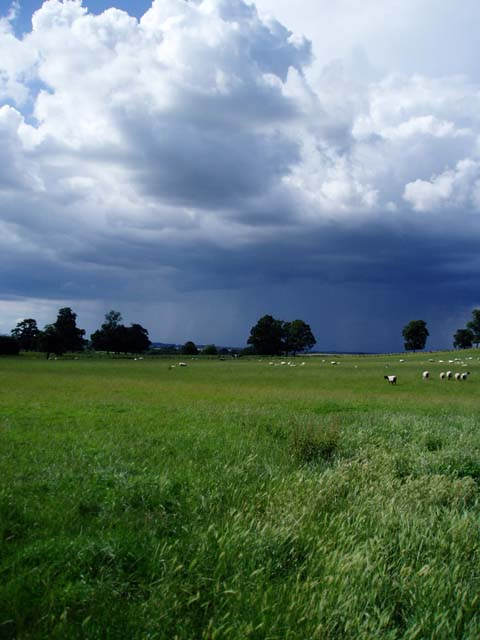
9) Like rain sent down from the sky, our absolutes start out above us. The sky is symbolic of a higher, clearer, and purer Reality, its physical location signifying its superior quality. Water in the sky does not even have to look like the water on the earth for us to believe in the vertical connection between them, and that one comes from the other. Without having to precisely pinpoint their first address, we on earth can see and feel that our values come from a higher place that inspires, illuminates, sustains, and guides us.
To devalue something is to lower it in our opinion, not to raise it to some intermediate level – which means that we instinctively associate value with height. Our language is soaked in a reality whereby even brute facts require the light touch of an onlooker’s appreciation to appear. Reality, in short, is felt and known to have an undeniably vertical dimension – one that we feel from infancy as we look up into the wise and caring faces of our parents and teachers.
3) One fascinating aspect of water is that we never see as much of it as there is actually present. Experts tell us that a tree is made up of approximately 50 percent water, depending on its age and species, and that the human body varies from about 78 percent water at birth to around 50 percent as we grow older. If this worldly life is like water, therefore, then its Reality is not just elusive but also hard to imagine and even harder to see.
If faith in AL-LAH were a house, then faith in the unseen – in the elusive aspect of Reality – would be its front porch. Believing that Reality is elusive does not mean that we simply accept rumours and speculative nonsense as true. Rather it is an awareness that there is a reverse face to reality, like the dark side of the moon, that we cannot always identify or describe, but for which we have sufficient evidence to accept its existence.
The first mention of faith in the Qur’an (Q2:3) does not say “in GOD”, but rather in this same hidden reality (al-ghaib). If you cannot believe in that, then your belief in God will necessarily be materialistic, idolatrous, and false. We know that there is water in the tree, even if we cannot see it when we cut it down and saw it into pieces. In the same way, the believer is convinced that there is a moral order that is commingled with our physical existence and is the source of its life and meaning. We ‘know’ that it is so by its effects, just as we know that the tree contains water by observing its foliage, its recurrent growth, and its deep roots and abundant fruits.
Some Sufis say that the destruction of this world is averted, likewise, by the presence in it of various ranks of saints, or awliya’, in numbers that vary in different narrations. They are not known and recognized by the general public. In fact, amongst them one does not know the other and they themselves are not aware of the validity of their actions and devotion. All these are hidden from them and the general public.1 Like the rainfall, they disappear into the environment, moistening the ground for all living creatures and ensuring that GOD’s Mercy is not suddenly withdrawn as if it had not flourished on the day before. At the individual level, moreover, guardian angels ward off spiritual harm we consequently never detect, and there are likewise elements within our souls that work for our benefit or detriment without our ever being aware of them.
Then to your Lord is your return, and He will tell you what you used to do. Indeed He is cognizant of what lies in [human] hearts. (Q39:7)
ثُمَّ إِلَى رَبِّكُمْ مَرْجِعُكُمْ فَيُنَبِّئُكُمْ بِمَا كُنْتُمْ تَعْمَلُونَ إِنَّهُ عَلِيمٌ بِذَاتِ الصُّدُورِ
6) Reality fills our stomachs, minds, and hearts as we – the people and the livestock – consume it. But we consume it indirectly, as material, intellectual, and spiritual vegetation, and so almost always concern ourselves with it in terms of our benefit or loss and forget the Benefactor.
We are all recipients of His gifts, and they are effective in all of us. But the affective impact – how we feel as a result of His acts of Generosity – differs markedly from one person to the next. The vast majority of people, when they receive something from Him, are overjoyed by the gift and, as persons over things, believe they are the masters of it. Despite GOD being the Ultimate Cause and Donor, they immediately look for a material cause to explain how the gift came to them, and proceed to work for continuance and control of that cause.
A second type – also a sizable group – believe in God, but are overjoyed that it was to them that the gift came. They thus view God instrumentally, as a powerful force working on their behalf, for their ends, and confirming what they always thought themselves to be – a chosen people.
A third group comprises very few people indeed. They are overjoyed by Who gave them that gift. For these devoted subjects, no gift of His is too small or hard to see, and no recipient is more fortunate than another, even if they receive the least of all. To them, GOD makes a gift of Himself, filling their lives with His joy, no matter what they get or who they become. For them, Reality is a felt presence of lasting value, not a plastic thing, a cheap toy for children, or a flattering word that makes them swell with adolescent pride and self-importance.
 The GOD You Already Know