The Names of GOD
Let us, then renew our akhlaq by reintroducing ourselves to AL-LAH. What can we say of ourselves, except that we are His willing slaves? AL-LAH, however, has 99 ways of making Himself known to us — His Names.
What is the connection between His Names and our akhlaq? I suggest that we consider them as a useful medium between the unknowable immensity of His Character and the obvious limitations of ours. This medium could be represented in the form of a house.
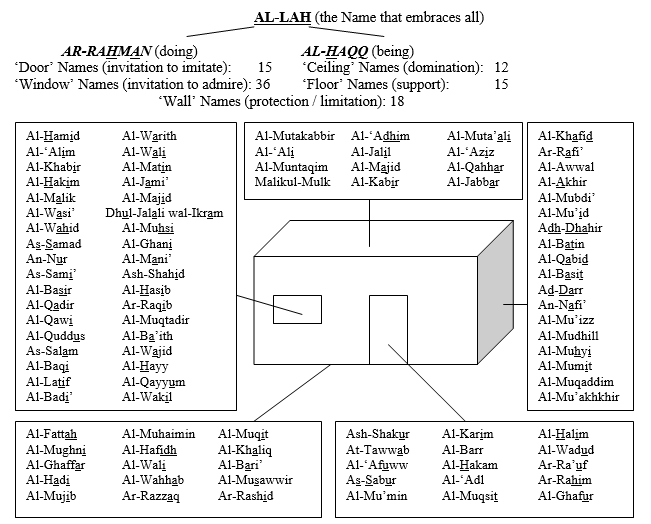
The House of Righteousness
The analogy of a house is fitting, I believe, because of its connection with the most general name for virtue, al-birr.
They question you about the phases of the moon. Reply, “They mark the times for men and for the pilgrimage.” It is not righteousness for you to come to houses from behind, but righteousness is one who has been wary. Come to houses by their doors, and mind AL-LAH that you might have success. (Q2:189)
يَسْأَلُونَكَ عَنْ الأَهِلَّةِ قُلْ هِيَ مَوَاقِيتُ لِلنَّاسِ وَالْحَجِّ وَلَيْسَ الْبِرُّ بِأَنْ تَأْتُوا الْبُيُوتَ مِنْ ظُهُورِهَا وَلَكِنَّ الْبِرَّ مَنْ اتَّقَى وَأْتُوا الْبُيُوتَ مِنْ أَبْوَابِهَا وَاتَّقُوا اللَّهَ لَعَلَّكُمْ تُفْلِحُونَ
‘Come to houses by their doors’ has become a proverb in Arabic, a way of recommending propriety in all things. The proper way to AL-LAH is through His Names. And the proper way to His Names, which form a type of home for our character, is by the door of righteousness. Here, please note, righteousness is not described as a code of behaviour, but is rather defined (as oddly in Arabic as it appears in English) in terms of “one who . . .”. In other words, akhlaq is focused on the person, not the action, and on a state of mind or heart, rather than any particular routine. Notice also that propriety takes the form of a direction – not the back, but the main (presumably the front) door. Finally, it is well worth remarking that GOD’s door for us is His ‘door’ Names, which are those we are encouraged to ‘act out’ in our own lives. We come to know Him by imitating some, and only some, of His Qualities. Here are examples of what to pursue, and what to avoid.
From Abi Hurairah, who said, “The Prophet (may AL-LAH bless him and give him peace) said, ‘Verily kindred are furrows for planting by the Gracious. GOD said, “With whoever connects you I have connected, and whoever cuts you I have cut.”’” (Sahihul-Bukhari, Book 78, Hadith 19)
عَنْ أَبِي هُرَيْرَةَ ـ رضى الله عنه ـ عَنِ النَّبِيِّ صلى الله عليه وسلم قَالَ إِنَّ الرَّحِمَ سُجْنَةٌ مِنَ الرَّحْمَنِ، فَقَالَ اللَّهُ مَنْ وَصَلَكِ وَصَلْتُهُ، وَمَنْ قَطَعَكِ قَطَعْتُهُ
From Abi Hurairah, who said, “The Messenger of AL-LAH (may AL-LAH bless him and give him peace) said, ‘GOD the Mighty and Glorious said, “Pride is My Cloak and Magnificence is My Mid-Wrap, and so I throw in the Fire whoever seeks to contend with Me in one of them.”’” (Sunanu Abi Dawud, Book 34, Hadith 71)
عَنْ أَبِي هُرَيْرَةَ قَالَ قَالَ رَسُولُ اللَّهِ صلى الله عليه وسلم قَالَ اللَّهُ عَزَّ وَجَلَّ الْكِبْرِيَاءُ رِدَائِي وَالْعَظَمَةُ إِزَارِي فَمَنْ نَازَعَنِي وَاحِدًا مِنْهُمَا قَذَفْتُهُ فِي النَّارِ
The Qur’an’s emphasis on virtue as direction and personal identity is confirmed in another verse.
It is not righteousness that you should turn your faces to the east or west, but righteousness is one believing in AL-LAH, the Final Day, the angels, scripture, and the prophets. (Q2:177)
لَيْسَ الْبِرَّ أَنْ تُوَلُّوا وُجُوهَكُمْ قِبَلَ الْمَشْرِقِ وَالْمَغْرِبِ وَلَكِنَّ الْبِرَّ مَنْ آمَنَ بِاللَّهِ وَالْيَوْمِ الآخِرِ وَالْمَلاَئِكَةِ وَالْكِتَابِ وَالنَّبِيِّينَ
The verse begins by orienting us to a deeper understanding of what kind of facing is expected of us. The face of righteousness is, once again, a personal concern (note, again, the use of the term one), and its direction is faith, followed by a long list of pious deeds and good character traits. Clearly, GOD does not want us to separate His Truth from matters of personality, or good character from faith and worship. They belong together, face to face.
The House of Light
The Verse of Light is one of the most important in the Qur’an. It describes, by analogy and symbols, the mysterious connections among GOD, or His Light, the bearers of His Light, namely the angels, messengers, and prophets (upon all of them be peace), and the recipients of Light, namely mankind and all created beings. We cannot delve here into a discussion of its many meanings (for which, see Chapter 18), but we should at least look at it, and the two verses following it.
AL-LAH is the Light of the heavens and the earth. The likeness of His Light is of a niche, wherein there is a lamp. The lamp is in a glass. The glass is as it were a pearly star, ignited from a blessed olive tree, not of the east nor of the west. Its oil is almost luminous, though fire does not touch it. Light on Light! / AL-LAH gives guidance to His Light to whom He wills. And GOD makes parables for men. And GOD has knowledge of all things. / In houses GOD has let be raised up and His Name be told therein. Revering Him therein by morning and at end of day / Are men whom trade and business do not distract from mentioning AL-LAH, performing prayers, and giving alms. They fear a day when hearts and sight are overturned.” (Q24:35-37)
اللَّهُ نُورُ السَّمَاوَاتِ وَالأَرْضِ مَثَلُ نُورِهِ كَمِشْكَاةٍ فِيهَا مِصْبَاحٌ الْمِصْبَاحُ فِي زُجَاجَةٍ الزُّجَاجَةُ كَأَنَّهَا كَوْكَبٌ دُرِّيٌّ يُوقَدُ مِنْ شَجَرَةٍ مُبَارَكَةٍ زَيْتُونِةٍ لاَ شَرْقِيَّةٍ وَلاَ غَرْبِيَّةٍ يَكَادُ زَيْتُهَا يُضِيءُ وَلَوْ لَمْ تَمْسَسْهُ نَارٌ نُورٌ عَلَى نُورٍ يَهْدِي اللَّهُ لِنُورِهِ مَنْ يَشَاءُ وَيَضْرِبُ اللَّهُ الأَمْثَالَ لِلنَّاسِ وَاللَّهُ بِكُلِّ شَيْءٍ عَلِيمٌ
فِي بُيُوتٍ أَذِنَ اللَّهُ أَنْ تُرْفَعَ وَيُذْكَرَ فِيهَا اسْمُهُ يُسَبِّحُ لَهُ فِيهَا بِالْغُدُوِّ وَالآصَالِ
رِجَالٌ لاَ تُلْهِيهِمْ تِجَارَةٌ وَلاَ بَيْعٌ عَنْ ذِكْرِ اللَّهِ وَإِقَامِ الصَّلاَةِ وَإِيتَاءِ الزَّكَاةِ يَخَافُونَ يَوْمًا تَتَقَلَّبُ فِيهِ الْقُلُوبُ وَالأَبْصَارُ
The symbolism of the house should, by now, be clear. Truth originally has no direction, neither east nor west, but the niche at the beginning of the parable has a front and a back, as do the houses at the beginning of the next verse, and the men at the beginning of the verse following. Niche, house, man – all have direction, or purpose, and face, or personality. Just as the lamp is to the niche, so is the man to the house, and the heart to the man. From Heaven to heart, the light of Character has shown us its face, and found its place. Let us turn, then, to look down – as GOD Himself might look – to where this light is planted, and the place from which it grows: the self.
 The GOD You Already Know