The Demanding Soul
In Q12:53, the Prophet Yusuf (upon whom be peace) declares:
And I do not absolve myself. Indeed the self is an inciter to iniquity, except for that on which my Lord has mercy. Verily my Lord is Pardoning, Compassionate.
وَمَا أُبَرِّئُ نَفْسِي إِنَّ النَّفْسَ لَأَمَّارَةٌ بِالسُّوءِ إِلاَّ مَا رَحِمَ رَبِّي إِنَّ رَبِّي غَفُورٌ رَحِيمٌ
This is a shocking admission for a prophet to make. Why would he not simply proclaim his innocence and, being a prophet, his state of Divine Protection from sin? The issue is clarified in another verse (Q12:24):
And she desired him. And he would have desired her if he had not perceived the demonstration of his Master. Thus [We did] in order to divert iniquity from him and fornication. He was one of our devoted slaves.
وَلَقَدْ هَمَّتْ بِهِ وَهَمَّ بِهَا لَوْلاَ أَنْ رَأَى بُرْهَانَ رَبِّهِ كَذَلِكَ لِنَصْرِفَ عَنْهُ السُّوءَ وَالْفَحْشَاءَ إِنَّهُ مِنْ عِبَادِنَا الْمُخْلَصِينَ
In both verses we notice an initial or natural propensity to sin that is overridden by the exceptional (underscored words in both English versions) intervention of GOD’s Grace or Power to convince. The field of the soul, if left untended by GOD’s Mercy, tends to produce the weeds of selfish desires. The soul of a prophet has the same type of soil as any one of us; what distinguishes him is the intensity of cultivation that makes him totally devoted to GOD. There is no cultivation nor growth without dirt. But what is dirt when the Cultivator is GOD?
In Sahihu Muslim, Book 52, Hadith 62:
From ‘Abdi-Lahib-ni Mas’ud, who said, “The Messenger of AL-LAH (may AL-LAH bless him and give him peace) said, ‘There is no one of you except that an attendant from the jinn has been assigned to him.’ [Those present] asked, ‘And to you?’ He replied, ‘And to me, but AL-LAH helped me against him, and he submitted, and so he only commands me to what is good.’”
عَنْ عَبْدِ اللَّهِ بْنِ مَسْعُودٍ، قَالَ قَالَ رَسُولُ اللَّهِ صلى الله عليه وسلم مَا مِنْكُمْ مِنْ أَحَدٍ إِلاَّ وَقَدْ وُكِّلَ بِهِ قَرِينُهُ مِنَ الْجِنِّ. قَالُوا وَإِيَّاكَ يَا رَسُولَ اللَّهِ قَالَ وَإِيَّاىَ إِلاَّ أَنَّ اللَّهَ أَعَانَنِي عَلَيْهِ فَأَسْلَمَ فَلاَ يَأْمُرُنِي إِلاَّ بِخَيْرٍ
And in Sahihul-Bukhari, Book 81, Hadith 52:
From Abi Hurairah (may AL-LAH be pleased with him), who said, “The Messenger of AL-LAH (may GOD bless him and give him peace) said, ‘Not one of you will be saved by his deeds.’ [Those present] asked, ‘Nor you, O Messenger of AL-LAH?’ ‘Nor me,’ he replied, ‘unless AL-LAH covers me with Mercy.’”
عَنْ أَبِي هُرَيْرَةَ ـ رضى الله عنه ـ قَالَ قَالَ رَسُولُ اللَّهِ صلى الله عليه وسلم لَنْ يُنَجِّيَ أَحَدًا مِنْكُمْ عَمَلُهُ قَالُوا وَلاَ أَنْتَ يَا رَسُولَ اللَّهِ قَالَ وَلاَ أَنَا، إِلاَّ أَنْ يَتَغَمَّدَنِي اللَّهُ بِرَحْمَةٍ
These sayings of the prophets reveal their good manners with AL-LAH. As it is said in Al-Hikam by Ibni ‘Ata’il-Lahil-Iskandari: “When the believer is praised, he feels ashamed before GOD Most High to be commended for attributes he does not find in himself.”
The Censorious Soul
AL-LAH describes the demanding soul, but He swears by the censorious soul – in a censorious tone of voice.
Nay! I swear by Resurrection Day! / And nay! I swear by the reproachful soul! / Does man believe that We shall not collect his bones? / We, on the contrary, are capable of levelling his fingertips. / But man desires to go on living dissolutely. (Q75:1-5)
لاَ أُقْسِمُ بِيَوْمِ الْقِيَامَةِ
وَلاَ أُقْسِمُ بِالنَّفْسِ اللَّوَّامَةِ
أَيَحْسَبُ الإِنسَانُ أَلَّنْ نَجْمَعَ عِظَامَهُ
بَلَى قَادِرِينَ عَلَى أَنْ نُسَوِّيَ بَنَانَهُ
بَلْ يُرِيدُ الإِنسَانُ لِيَفْجُرَ أَمَامَهُ
This entire Surah is full of turmoil, confrontation, questioning, correction, contrast, reproach, and resurrection. The word for living dissolutely is constructed from the root f-j-r, from which an interesting array of verbs is derived: to cleave, break up, dig up (the ground); to let (water) flow forth; to break forth, burst out; to explode, overflow, descend suddenly, rush in, and swoop down. From the same root we have fajr, which means “dawn” or “beginning”.
Al-Fajr is the title of the chapter in which AL-LAH begins with swearing by the daybreak and ends by calling to the tranquil soul. After describing peoples of the past who were destroyed in the midst of their power and static, stone-like pride, AL-LAH goes on to chide mankind and warn of the tumultuous calamities to come. Only then, when the Earth is pulverized to dust, does His Kingdom become totally manifest, and in that sudden clarity He calls out to the soul who has struggled through to serenity.
The Tranquil Soul
And so we read in Q89: 27-30:
O you tranquil soul! / Return to your Lord, satisfied and satisfying! / Enter in among My servants. / Enter in My Paradise.
يَا أَيَّتُهَا النَّفْسُ الْمُطْمَئِنَّةُ
ارْجِعِي إِلَى رَبِّكِ رَاضِيَةً مَرْضِيَّةً
فَادْخُلِي فِي عِبَادِي
وَادْخُلِي جَنَّتِي
Here there is no detachment or estrangement, but rather a harvest of contentment and the voice of familiarity and blessing. Demands and fault-finding have finally come to an end. Any progress from this point onwards is fully productive, integrated, and satisfying. Here one enters into the Life of Divinity, where words are too feeble to convey the bliss and beauty of it all.
This progression – from the demanding soul through the censorious soul to the tranquil soul – is evident in the threefold symbolism:
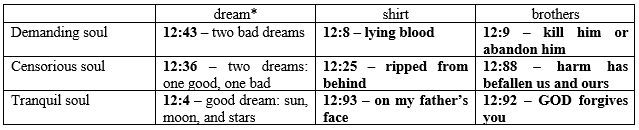
* The dreams take place in inverse order in the story because they descend from GOD to man, rather than rising from man to GOD.
Certainly in Yusuf and his brothers are signs for those who ask [or seek]. (Q12:7)
لَقَدْ كَانَ فِي يُوسُفَ وَإِخْوَتِهِ آيَاتٌ لِلسَّائِلِينَ
Food for the Journey
The growth of the soul towards GOD does not take place in one dimension, nor is it accomplished in three discrete stages. Rather it is repeated time and time again, in new forms and with increasing complexity and progressive refinement. Each stage is necessary to the one following it, just as each type of life form serves as food for the form above it.
There is no struggle without disorder before it, and no real peace without a prior struggle. The levels of spirituality through which we must pass are symbolized for us in the food chain, where soil is food for plants, plants food for animals, and animals food for man. And this graduated submission of one level to the one above it goes on and on. Our food fuels our passions, which if cultivated become sentiments, which in turn supply the materials for ideas, and ideas for beliefs, and so on toward heavenly inspirations and perfect faith in AL-LAH.
Considered in this way, the self is not so much “who you are” as “what you consume”. Your “self” is not really an identity at all, but merely food for something higher. Worldlings say, “We are what we eat,” for that is all they know. Believers say, “Only GOD knows who we are,” for in their growth there is no stationary being, but rather a constant growing wiser, and becoming otherwise.
In a good hadith narrated by Ibni Majah, the Prophet (may AL-LAH bless him and give him peace) said:
What is this world to me? With this world, I am only like a rider who rests in the shade of a tree, then gets up and leaves it.
مَا أَنَا وَالدُّنْيَا إِنَّمَا أَنَا وَالدُّنْيَا كَرَاكِبٍ اسْتَظَلَّ تَحْتَ شَجَرَةٍ ثُمَّ رَاحَ وَتَرَكَهَا
And in Sahihul-Bukhari:
From ‘Abdi-Lahib-ni ‘Umar (may AL-LAH be pleased with them both), who said, “The Messenger of AL-LAH (may GOD bless him and give him peace) took me by the shoulder and said, ‘Be in this world as if you were a stranger or a traveller.’”
عَنْ عَبْدِ اللَّهِ بْنِ عُمَرَ ـ رضى الله عنهما ـ قَالَ أَخَذَ رَسُولُ اللَّهِ صلى الله عليه وسلم بِمَنْكِبِي فَقَالَ كُنْ فِي الدُّنْيَا كَأَنَّكَ غَرِيبٌ، أَوْ عَابِرُ سَبِيلٍ
 The GOD You Already Know