The material in this blog is now available at amazon.com under the title: Ideas Inspired by the Qur’an.

The paradoxical nature of fire should be obvious by now. On the one hand, the Qur’an constantly refers to it as something close to a synonym for Hell itself. On the other hand, also in the Qur’an, it receives favourable mention in the parable of Light and in the story of Musa’s first encounter with revelation. It is clearly a destructive force, but the first reference to it in the Qur’an is associated with the light of guidance (Q2:17). Unlike the Garden, which grows luxuriantly, fruitfully, and never dies, fire tends to diminishment and exhaustion, yet its inhabitants are said to stay in it forever. How can we reconcile these disparities? Or do they, rather, symbolize a deeper polarity that holds in balance the natural contradictions of spiritual life itself?
The Fire of God must be both a scourge and a blessing, equally painful and necessary. I take that to be the relentless inner smoldering of Conscience – something that is terrible to lose, and yet equally disastrous to feed unchecked. To lose it now is to encounter it later in material form, in Hell. To give it full rein is to become demonically obsessive about always being right. Unmodulated, this fire parches the souls of the fanatics whom
It does not preserve nor let them be, / The scorcher of the skins of men. (Q74:28-29)
لاَ تُبْقِي وَلاَ تَذَرُ
لَوَّاحَةٌ لِلْبَشَرِ
We see this ruthless, unscrupulous, inhumane certainty of one’s own rightness in the story of Iblis, the father or headmaster of all the demons who have ever lived as jinn or in human form. Indeed, the most likely etymology for Satan (Shaitan), the generic name for all devils, is shata, meaning to burn, flare up, or rage. (I cannot confirm with complete certainty what the Arabic root of Shaitan is, but my trusty Arabic-English dictionary is giving me a fairly clear hint here.)
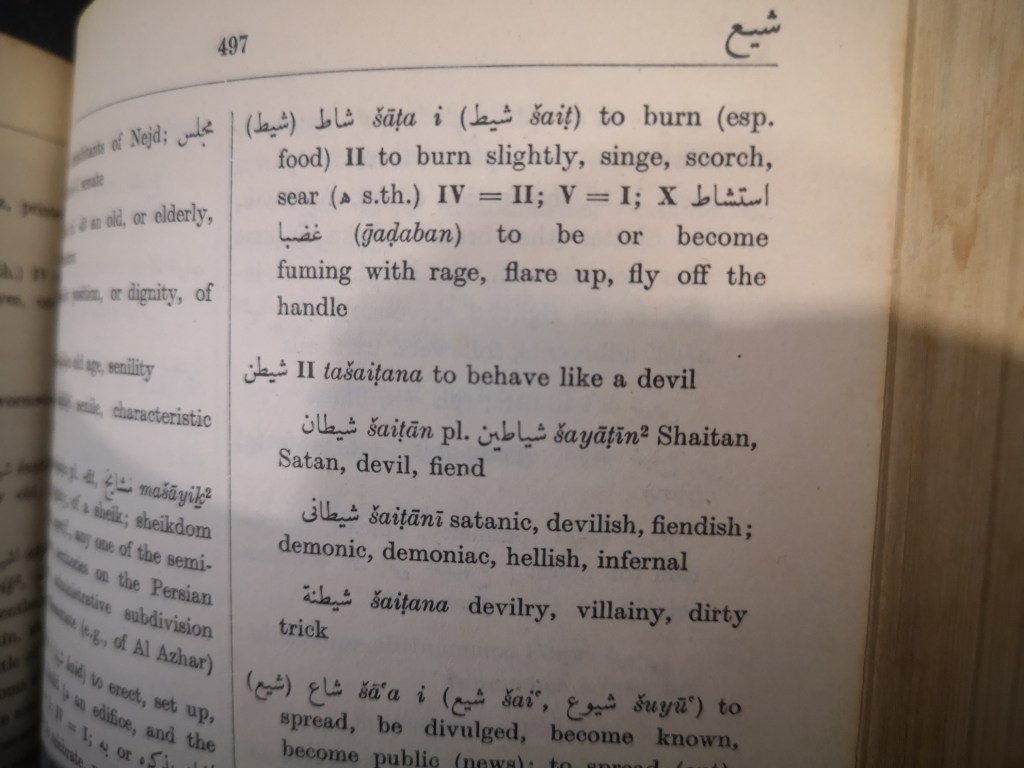
The rebellion of Iblis, described on numerous occasions in the Qur’an, was the action of a proud paragon of devotion who was convinced that GOD had done him wrong, and that he was right. The wrath of injured pride consumed him as he surveyed the contemptible being, made of clay, who had been placed before him in the sight of GOD. He vowed to wage what he believes to be a holy war against this unjustly elevated upstart. And thus all the crimes of Satan are, despite their obvious evil, emblazoned with the argument of the end justifying the means. All he has to do is prove that GOD has erred, and that his insubordination was in the cause of truth. One could say, in fact, that the devil is in love with truth – his truth. He burns with the vehemence of his righteous anger.
There are, at the other extreme, insensible brutes whose moral compass is so sluggish as to barely register them as human. I am speaking here not of their intelligence, but of empathy for their fellow creatures. These are the psychopathic politicians, corporate executives, and common criminals who, with a stroke of the pen or a curl of the lip, command or condone the deaths and suffering of millions of innocents and then say that it was worth it. Their hearts are so hard that nothing but the Fire of GOD can penetrate them, find the good in them, and extract it over a long process described in terms of hooks, spears, bitter fruits, scalding drinks, and vigorous application of the warmth that had been buried and supposed lost within their souls.
And GOD brings forth what you were wont to hide. (Q2:72)
وَاللَّهُ مُخْرِجٌ مَا كُنتُمْ تَكْتُمُونَ
With this latter type – the dull, the unfeeling, the blobs of humanity who care nothing for goodness or truth – Hell has its fuel.
Ward off the Fire whose fuel is men and stones, prepared for the ungrateful. (Q2:24)
فَاتَّقُوا النَّارَ الَّتِي وَقُودُهَا النَّاسُ وَالْحِجَارَةُ أُعِدَّتْ لِلْكَافِرِينَ
Some of us are devils in human form, and our fire is within. And others of us – the vast majority – are fuel in human form; our destined portion of the Fire is outside, trying to get in. And thus, with a combination of fury and indifference, the composition of Hell is complete, and the action can get under way.


In Arabic , is the root word for شيطان = شط؟
Also,If I were to update the title of this book would choose:
The Pearls of Wisdom
LikeLike
That is also possible, as the root of شطط in Arabic means “to go to extremes, go too far; . . . to deviate,” according to my old copy of the Hans Wehr Arabic-English dictionary (which I highly recommend, by the way). But in support of my suggestion, I offer a snapshot from my dictionary on this page, above.
LikeLike